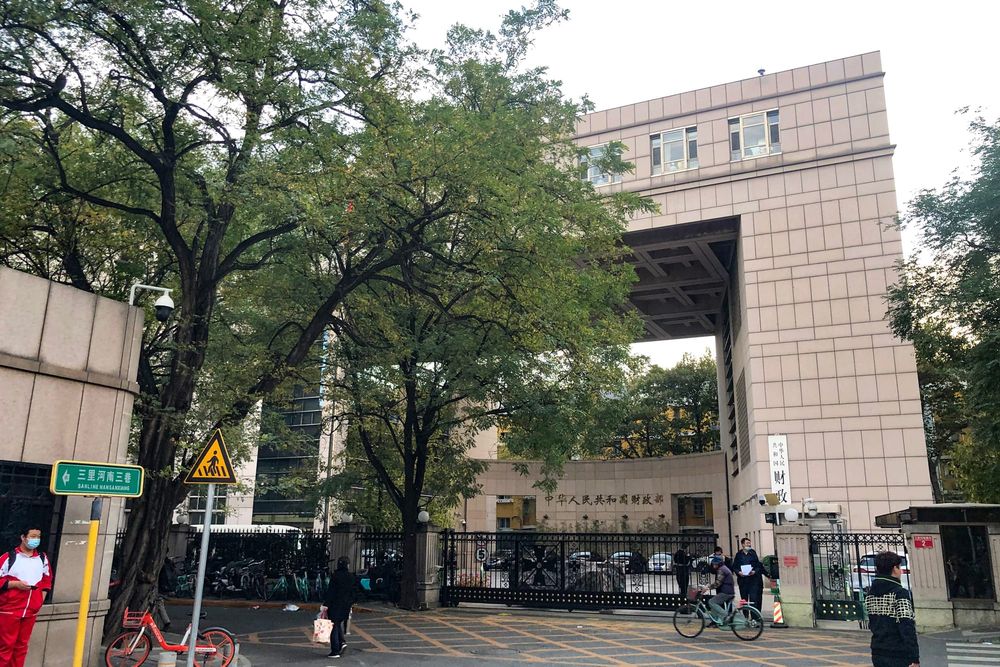
China's Ministry of Finance said on Monday it would soon issue 300 billion yuan in special treasury bonds to replenish the core Tier 1 capital of eight state-owned financial enterprises directly administered by the central government, formalising a recapitalisation package the institutions themselves had disclosed a day earlier. The eight firms said on Sunday they would raise or receive a combined 360 billion yuan, equivalent to about $53.6 billion, with the remaining 60 billion yuan coming from share subscriptions by China National Tobacco Corporation and its related subsidiaries. The recipients comprise two major state-owned commercial banks, Industrial and Commercial Bank of China and Agricultural Bank of China; two policy institutions, the Export-Import Bank of China and China Export & Credit Insurance Corporation; and four state-owned commercial insurers, People's Insurance Company (Group) of China, China Life Insurance (Group) Company, China Taiping Insurance Group and China Reinsurance (Group) Corporation. The ministry said the exercise would be carried out prudently in accordance with market-oriented and law-based principles.
The package extends a fiscal financing tool first deployed at scale in 2025, when the ministry channelled 500 billion yuan into four major state-owned commercial banks. With ICBC and Agricultural Bank of China included in this round, all six of China's major state-owned commercial banks have now received capital support across the two rounds of fiscal injections. The plan was first flagged at the annual parliamentary meeting in March this year. It marks the first time the special-bond mechanism has been extended to insurers, a sector that had previously fallen outside the instrument's scope.
BANKS TAKE THE LARGEST SHARE
Three state lenders accounted for the bulk of the programme, announcing a combined 290 billion yuan in capital injections. Agricultural Bank of China said it planned to raise up to 160 billion yuan and ICBC up to 100 billion yuan, both through private placements of A-shares to the finance ministry, China National Tobacco Corporation and its subsidiaries. Both lenders said the proceeds would be used entirely to replenish core Tier 1 capital, the highest-quality loss-absorbing capital and the constraint that governs how far a bank can expand its loan book while remaining within regulatory ratios. The Export-Import Bank of China, one of the country's three policy lenders, said the ministry would inject 30 billion yuan to strengthen its capital base and support major national strategies.
The injections respond to a squeeze on internal capital generation across the Chinese banking system. Weak loan demand remains a persistent drag on the world's second-largest economy and has eroded sector profitability, while falling interest rates and narrowing net interest margins have reduced banks' capacity to accumulate capital from retained earnings. Dong Ximiao, chief economist at Merchants Union Consumer Finance Company Limited, described the injection as a forward-looking strategic move, noting that global systemically important banks such as ICBC face higher additional capital requirements as they move into higher regulatory buckets. Lou Feipeng, a researcher at China Postal Savings Bank, said the replenishment would support ICBC and Agricultural Bank of China in expanding lending in line with economic development needs.
INSURERS BROUGHT INTO THE SCHEME
On the insurance side, China Life Insurance (Group) Co, the country's largest life insurer, will receive 35 billion yuan, and China Taiping Insurance Group 7 billion yuan. People's Insurance Company (Group) of China said it planned to raise up to 15 billion yuan through a private placement of A-shares to the ministry, China Export and Credit Insurance Corporation said the ministry would inject 10 billion yuan into its core capital, and China Reinsurance (Group) said it would raise 3 billion yuan. China Life said the injection was an important step to enhance the financial sector's ability to serve the real economy and would strengthen the group's ability to withstand risks, while Taiping said the funds would bolster its solvency and other key indicators. The sector has been contending with eroding profitability from persistently low interest rates, with numerous small and mid-sized insurers reporting deteriorating solvency ratios.
Analysts cited by state media expect the bank and policy-lender injections to carry a multiplier effect, potentially unlocking additional lending capacity and directing financing toward technology, green development and infrastructure. For the insurers, the immediate question is whether stronger capital positions ease the solvency constraints that have limited how much equity-market risk they can carry, given earlier official direction to deploy medium- and long-term funds into stocks. The finance ministry said the eight institutions are operating steadily, with stable asset quality and major regulatory indicators within safe ranges. Timing and pricing of the special treasury bond issuance, and the completion of the individual private placements, remain the near-term markers of execution.