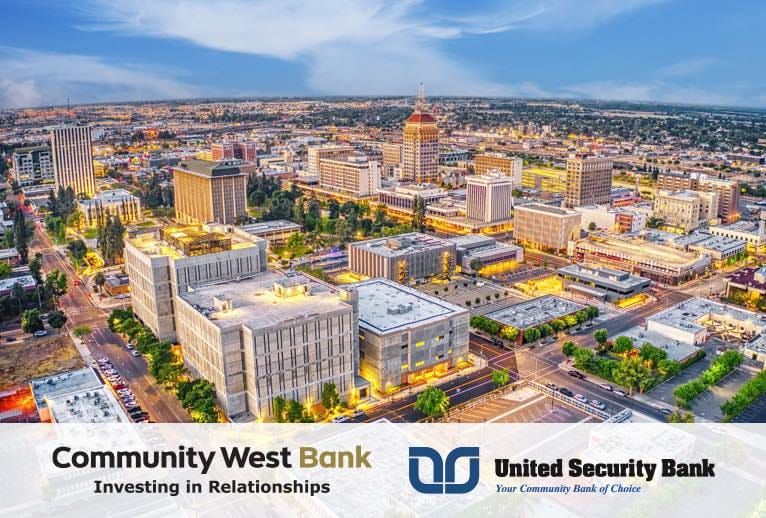
Community West Bancshares and United Security Bancshares have completed their previously announced merger, effective 1 April 2026, forming a combined community banking institution with approximately $5 billion in total assets. The transaction, announced in December 2025 and cleared by relevant regulatory authorities in the normal course ahead of the effective date, creates the largest community bank by deposit market share in California's Central Valley, where the combined institution holds a 9.27% share, according to the announcement published by the group.
Both Community West Bank and United Security Bank will continue to operate as banking subsidiaries within the combined holding company structure, preserving the branch locations and local banking relationships of each predecessor institution. The decision to maintain both networks is consistent with the strategic logic underpinning the merger, which centres on serving a regional customer base that values the accessibility and relationship-driven service model associated with community banking, rather than the standardised national retail formats of larger competitors operating across the same geography.
BUILDING THE CENTRAL VALLEY'S LARGEST COMMUNITY BANK
The Central Valley of California is one of the United States' most agriculturally productive regions and supports a broadly diversified economy anchored by farming, food processing, logistics, healthcare, and a range of industries that generate sustained demand for commercial lending, agribusiness finance, and small business banking services. A combined institution with $5 billion in assets carries considerably greater lending capacity than either predecessor bank operating independently, enabling the merged entity to accommodate larger credit requirements that might otherwise push customers towards the regional or national institutions that have historically dominated higher loan-size segments.
The 9.27% deposit market share figure positions the combined bank as the leading community banking presence in the Central Valley, a distinction that is commercially meaningful in a region where community banks compete directly against the retail and commercial networks of the nation's largest institutions. Deposit market leadership in a defined geography provides a funding advantage that supports lending activity across all segments the bank serves, making the combined franchise's market position a structural operational strength that neither predecessor bank could have claimed independently.
Retaining both the Community West Bank and United Security Bank branded office locations signals a management philosophy of preserving local identity and staff continuity through the integration period, a posture that community bank customers and employees typically respond to more positively than rapid branch consolidation aimed at short-term cost reduction. Relationship lending, the core product of a community bank franchise, depends fundamentally on the stability of the banker-client relationship, and protecting that continuity is central to capturing the projected revenue synergies over time.
INTEGRATION AND CLIENT CONTINUITY
Community bank mergers in regional markets frequently encounter client attrition risk when branch consolidation or operational disruption signals a departure from the highly localised service model that customers selected when choosing their banking provider. The combined management team's commitment to retaining both branch networks and to operational continuity during the integration reduces this risk materially, though the work of aligning technology systems, credit policies, and internal processes across the two organisations will require sustained focus and careful execution over the coming months.
The completion of the merger positions the combined institution to pursue further organic growth across the Central Valley from a stronger competitive base, backed by the enhanced capital and balance sheet scale that comes with operating as a $5 billion-asset bank. The newly combined group's leadership will now concentrate on embedding the two organisations, demonstrating to shareholders, clients, and regulators that the strategic rationale for the combination is being delivered in practice, and building the platform for the next phase of growth in one of California's most economically significant regional markets.