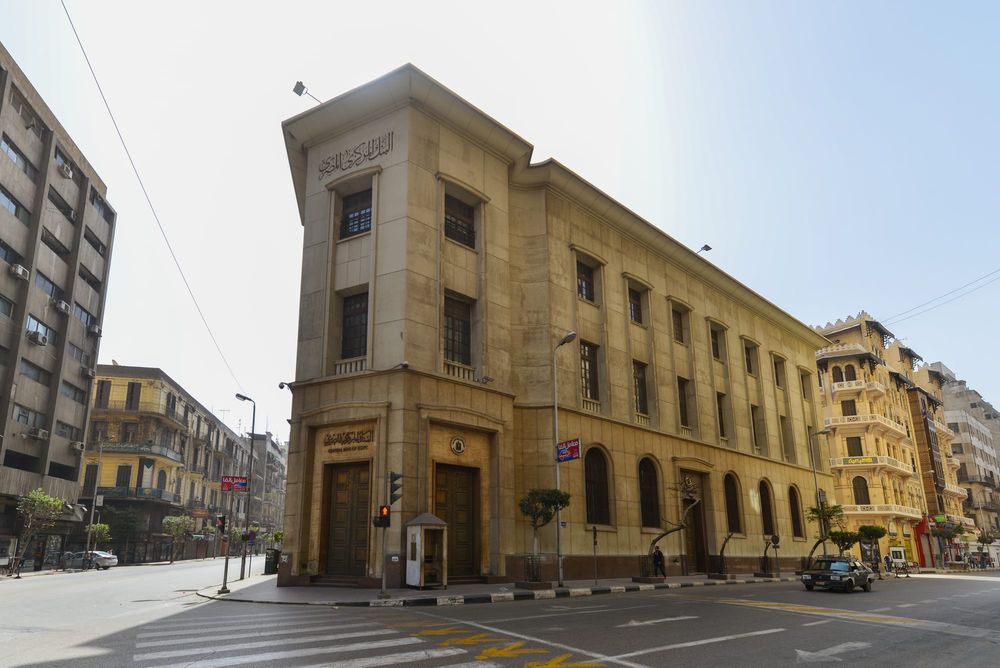
The Central Bank of Egypt reported that the banking sector's net foreign assets rose to $28.418 billion in July 2026, equivalent to EGP 1.454 trillion, from $27.965 billion, or EGP 1.378 trillion, in June. The figure covers the central bank together with all banks operating in Egypt, and represents a monthly gain of approximately $453 million, or about 1.6 per cent in dollar terms. Total foreign assets held by the banking system reached the equivalent of EGP 5.146 trillion, against EGP 4.939 trillion a month earlier. Foreign liabilities also increased over the period, rising to EGP 3.691 trillion from EGP 3.591 trillion.
The disclosure landed alongside a separate central bank announcement on Monday that Egypt's net international reserves climbed by $920 million during August to a record $57.2145 billion, up 1.6 per cent from $56.29 billion at the end of July. Reserves stood at $55.07 billion in June, $53.13 billion in May and $53 billion in April, and compared with $49.2507 billion a year earlier. Taken together, the two series point to a continued rebuilding of Egypt's external buffers through the middle of the year. Net foreign assets are treated as one of the more reliable monthly indicators of banking stability, measuring the difference between the sector's foreign-currency assets and its foreign-currency obligations.
CURRENCY EFFECTS BEHIND THE HEADLINE FIGURE
The scale of the improvement depends materially on the currency in which it is measured. In Egyptian pounds, the net foreign asset position advanced roughly 5.5 per cent between June and July, while the dollar-denominated increase was approximately 1.6 per cent. The divergence reflects movement in the exchange rate, with the pound trading at about 51.1934 to the dollar in July against roughly 49.2763 in June. Converting foreign holdings at a weaker rate mechanically inflates the local-currency total without any corresponding change in the underlying stock of foreign currency.
The expansion on both sides of the balance sheet carries its own signal. Gross foreign assets and gross foreign liabilities each grew during the month, a pattern generally read as banks intermediating cross-border flows rather than accumulating foreign currency defensively. Composition, however, remains the more consequential question than the aggregate. Short-term deposits placed from abroad can be withdrawn on comparable notice, and the durability of the position depends on how much of it rests on such funding.
EXTERNAL POSITION AND REMAINING PRESSURES
The July reading extends a recovery visible across the central bank's own series. Net foreign assets stood at $22.9 billion in April 2026 and $23.73 billion in November 2025, placing the latest figure well above levels recorded earlier in the cycle. The turn followed Egypt's large currency devaluation and the Gulf investment that succeeded it, which eased an acute dollar shortage that had at one stage left imports stranded at the country's ports. Remittance flows recovered once the official and parallel exchange rates converged, and the International Monetary Fund programme has maintained the sequencing of reforms, with periodic reviews functioning as a constraint on fiscal policy.
Constraints persist. A meaningful share of the improvement is attributable to portfolio inflows drawn by elevated local interest rates, a category of funding historically among the first to reverse when global conditions shift. External debt service obligations are substantial in coming years, and the Gulf support extended in 2024 was one-off in character. Suez Canal receipts remain below pre-disruption levels, with Red Sea traffic yet to normalise, leaving a revenue gap the budget continues to absorb. Attention now turns to the August net foreign asset series and to Egypt's next IMF review, approval of which would unlock financing and confirm to portfolio investors that the programme remains on course.