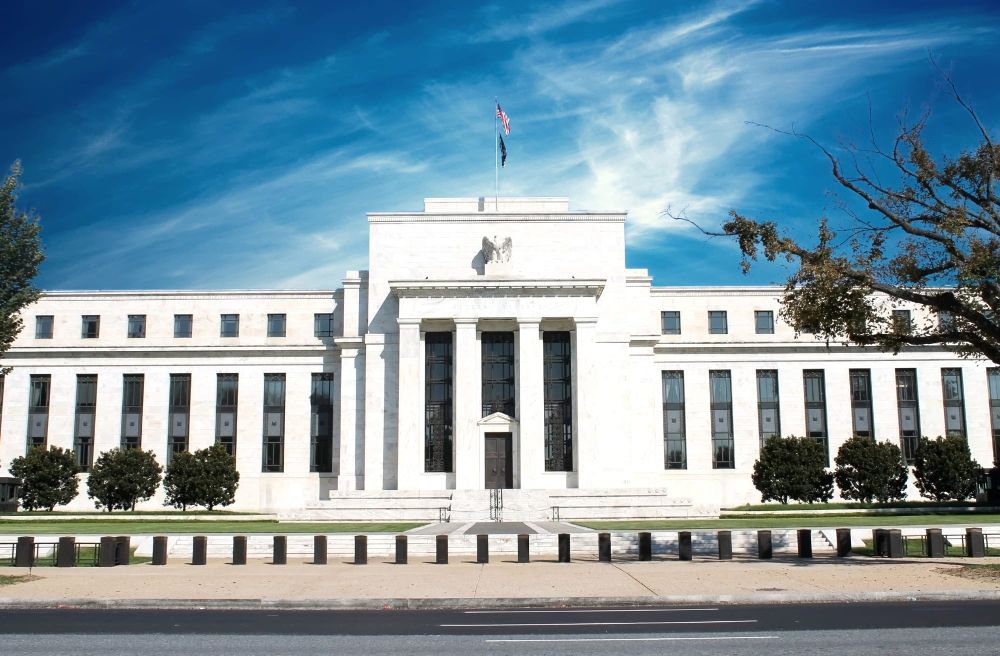
The Federal Reserve held the target range for the federal funds rate at 3-1/2 to 3-3/4 percent on Wednesday, in what will be the last policy meeting chaired by Jerome Powell. The Federal Open Market Committee voted 8-4 to keep policy unchanged, marking the most divided FOMC decision since 1992.
The dissenters split in opposite directions on the appropriate policy stance. Governor Stephen Miran dissented in favour of an immediate 25 basis point cut, while Beth Hammack, Neel Kashkari and Lorie Logan objected to the inclusion of an easing bias in the accompanying statement. The result is a Committee that is publicly divided both on the level of rates and on the direction of the guidance.
MOST DIVIDED VOTE IN A GENERATION
A four-way split on the Committee is exceptionally rare and speaks to the difficulty of calibrating policy in an environment marked by higher energy prices and geopolitical uncertainty. The last time an FOMC decision produced this level of dissent was in 1992, according to the Fed's records. The scale of disagreement will be seized upon by market participants trying to divine the trajectory of policy under Mr Powell's successor.
The statement cited elevated inflation, partly attributable to higher global energy prices, and singled out uncertainty stemming from the Middle East as a risk to the outlook. Those references appear to have underpinned both the majority's decision to hold and the dissents on either side of the debate. The staff assessment underlying the decision has evidently been read very differently by policymakers depending on the weight they place on inflation persistence versus growth risks.
Governor Miran's preference for an immediate quarter-point cut reflects a view that policy remains too restrictive given the balance of risks to activity. The three other dissenters took the opposite line, objecting not to the level of rates but to language that they viewed as tilting the guidance too far toward easing. Together, the dissents highlight a Committee genuinely split over whether the greater risk lies with sticky inflation and the possibility of further supply shocks, or with a weakening labour market and softer growth.
END OF THE POWELL ERA
The meeting closes the policymaking chapter of Mr Powell's tenure, which has spanned the pandemic-era emergency easing, one of the fastest tightening cycles in Fed history and the current phase of managing rates against a backdrop of geopolitical shocks. His successor will inherit a Committee that is more fractious than at any point in recent memory, and a communications framework that has to accommodate genuine disagreement on both direction and language.
The reference to Middle East uncertainty in the statement is unusually specific for the FOMC, which tends to avoid singling out particular geopolitical events. Its inclusion signals the extent to which policymakers see external risks as central to the current inflation outlook, and provides context for the dissent lodged by the more hawkish members who fear that second-round effects could take hold.
Investors will now turn to the transition of leadership at the central bank and the next round of communications from FOMC participants. The statement did not offer explicit calendar guidance on the next policy move, leaving the decision very much in the hands of Mr Powell's successor and of the members likely to influence the debate over the summer.