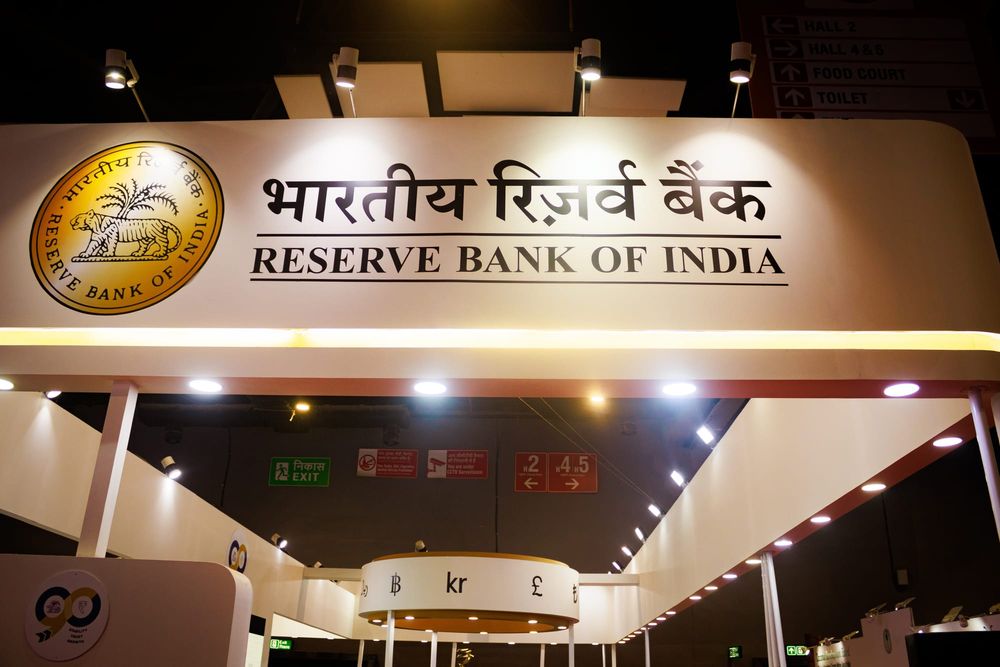
The Reserve Bank of India approved ICICI Prudential Asset Management Company to acquire an aggregate holding of up to 9.95% of the paid-up share capital or voting rights of AU Small Finance Bank, the Jaipur-based lender disclosed in a regulatory filing on Wednesday. AU Small Finance Bank said it received the central bank's approval letter dated 8 September 2026. The clearance covers ICICI Prudential Asset Management Company itself, along with the schemes of ICICI Prudential Mutual Fund, funds under alternative investment funds managed by the asset manager, and clients of its portfolio management services. The approval is subject to compliance with the applicable provisions of the Banking Regulation Act, 1949, RBI directions, the Foreign Exchange Management Act, 1999, and regulations issued by the Securities and Exchange Board of India. The filing did not indicate that the full 9.95% holding has been acquired.
The AU Small Finance Bank clearance forms part of a broader set of approvals granted to the asset manager on the same date. ICICI Bank, the fund house's parent, disclosed in a separate filing on 9 September that the RBI, through different letters dated 8 September 2026, permitted ICICI Prudential Asset Management Company to acquire aggregate holdings of up to 9.95% in four lenders — Kotak Mahindra Bank, CSB Bank, DCB Bank and AU Small Finance Bank. CSB Bank made its own disclosure on 8 September, confirming the same 9.95% ceiling for the Thrissur-based lender. The approvals require the applicant to acquire the major shareholding within one year from the date of the RBI letters, failing which they stand cancelled automatically.
REGULATORY FRAMEWORK AND CONDITIONS
Under sub-section (1) of Section 12B of the Banking Regulation Act, 1949, any person intending to acquire shares or voting rights that would make them a major shareholder of a banking company must obtain the Reserve Bank's previous approval. The RBI defines major shareholding as an aggregate holding of five per cent or more of the paid-up share capital or voting rights in a banking company, with applications submitted through the central bank's PRAVAAH portal. The threshold structure explains why an asset manager acting across mutual fund schemes, alternative investment funds and portfolio management mandates requires a single aggregate clearance rather than scheme-level permissions.
The conditions attached to the approvals extend beyond the one-year execution window. Should the aggregate holding subsequently fall below the five per cent threshold, the applicant must obtain fresh prior approval from the Reserve Bank before raising it back to five per cent or more of the bank's total paid-up capital or voting rights. The 9.95% ceiling sits below the 10% limit applicable to certain categories of non-promoter shareholders under the central bank's shareholding guidelines, and functions as a combined cap across all vehicles managed by the asset manager.
TIMING AGAINST AU'S TRANSITION
The approval lands as AU Small Finance Bank advances its move to universal bank status. The lender received the RBI's in-principle approval for the transition on 7 August 2025, valid for 18 months, becoming the first small finance bank in over a decade to secure such clearance. In a letter dated 6 March 2026, the regulator relaxed the requirement that promoters park their stake in a Non-Operative Financial Holding Company, stipulating that the NOFHC structure would apply only if the bank or its promoter group proposed to establish group entities in the future. Operationally, the bank reported profit after tax of ₹796 crore for the June 2026 quarter, up 37% year-on-year, with net interest income rising 32% to ₹2,695 crore and net interest margin at 5.9%. As at 30 June 2026, it held a deposit base of ₹1,57,727 crore and a total loan portfolio of ₹1,44,250 crore.
Execution now becomes the variable to monitor. The asset manager has until early September 2027 to build the permitted holdings across the four lenders, and any accumulation past the five per cent mark will surface in quarterly shareholding disclosures. The approvals also follow the RBI's clearance for Life Insurance Corporation of India to raise its stake in ICICI Bank to up to 9.99%, indicating continued regulatory willingness to grant large domestic institutional investors headroom in listed private-sector banks within defined one-year windows.